Only the best from a bulletin board full of experience in such varied interests as poultry, art, good food, and Ohio history.
Come along on the adventure!

Be sure to also check out ohloveofgeocaching.com for travel and caching adventures!
Showing posts with label Second Year. Show all posts

Tuesday, May 26, 2015

Back Indoors

Backyard Poultry
Settling Down
Soon, however, it was time to go back inside. These chicks were still a third the size of full-grown chickens, and three times more at risk of predators. There are, sadly enough, a number of predators that can capture a chick but are too small to grab a full-size chicken. Thus, I had to check frequently on these little chicks while they were out in their run to make sure they were safe. This translated into a fairly short stay outside, since I was not enjoying running back and forth from their house to mine. Getting them back indoors was a bit of a challenge, since they seemed to be a bit scared of going back in the door, but with some help I eventually got them all back in. Once inside, I did expand their living quarters even more. They seemed to demand more room to roam once they found out how much space is available outdoors. I think they enjoyed their little excursion.
Another Expansion

Sunday, May 24, 2015

Enjoying the Sunshine

Backyard Poultry
Finally Outdoors 
At last, each of the chicks had been outside at least once (regardless of whether it had immediately run back inside). Some of them were actually becoming rather contented outdoors. I was finally able to climb back out of the chicken house and come around to the pen. It was a beautiful sight to see the little chicks out and enjoying the sunshine. They were looking in wonder at the huge world around them. You might notice that many of them have their heads turned, looking up. They had never before been without a roof above their heads, ever since arriving as day-old chicks. Seeing only blue sky way up above was quite a shock, as well as a threat. Chickens are naturally afraid of anything airborne - even shadows - passing over their heads. After all, hawks, owls, and other such birds of prey will swoop down to make a catch on any exposed poultry. The absence of a roof signified this danger, and caused a reaction of caution from the chicks.

Friday, May 22, 2015

Helping Hand

Backyard Poultry
Pushing the Birds out of the Nest
To take care of those timid chicks, I decided it was time for a little human intervention. So I went around inside the chicken shed and climbed into the chicks' house (remember, it was still barricaded with cardboard and insulation). Grabbing each chick in turn, I gently but firmly directed each one out the door. Most of them tried to avoid getting caught, and all dragged their feet to stay as close to the doorstep as possible. Some of them even turned right around and tried to run back inside! This approach was not entirely successful, but it did expose all the chicks to the outdoor pen. Even if they ran back inside in terror (which actually couldn't happen until I got out of the door), they would be more likely to come back out and try it again. A number of the chicks did stay outside and look around though, as you can see in the picture below. Isn't it funny to see those two last little Rhode Island Reds clinging to the doorstep with their little toes?
Last Ones

Wednesday, May 20, 2015

Venturing Out

Backyard Poultry
The Brave and the Timid
The first few pullets finally made it out into the pen. Like the rooster, the Golden Buffs became interested in the bits of greenery as well as the novelty of dirt. Aren't they pretty in the afternoon sunshine? A few more pullets followed the lead of the Golden Buffs. Birchie, the white Araucana, bravely jumped down the cement steps, followed by a nervously curious Buff Orpington and Rhode Island Red. The others, however, would not venture out from the safety of the doorway. This often happens in a chicken flock. Though all the birds are scared at first, a few of them are brave enough to try out the new and scary activity or environment after a short while. However, others are too timid to ever give it a try, and may never become accustomed to the new environment. It seemed that might be true of the majority of my chickie flock this time.

Monday, May 18, 2015

Follow the Leader

Backyard Poultry
A Few More Venture Out
The brave little Rhode Island Red rooster soon overcame the fear of its first steps into the outdoors, and began to investigate a clump of grass in the dirt. There was too much to explore to stay frozen in one spot forever! Meanwhile, the bravest of the pullets began to follow the rooster's lead. Cautiously they stepped out onto the little cement stairs I had set up, all the while keeping a watchful eye on what the rooster was doing. The rest of the flock stayed safely indoors, some watching with interest, while others tried to pretend that nothing unusual was happening. This was certainly a different response than I had been looking for, but I really ought to have expected as much after more than a year of experience in chicken psychology!

Saturday, May 16, 2015

First Steps Out

Backyard Poultry
Peeking Out
Eagerly, I opened up the pop door into the newly-completed pen. I stood back and waited for the chicks to come pouring out excitedly. Nothing happened. Not only was the pen empty and still, but not even one chick could even be seen in the doorway! Peeking into the pop hole, I made out a huddled mass of nervous chicks in the very back of the chicken house. Then it dawned on me that these little birds were actually scared by the grating noise the door had made when I slid it open! How was I ever going to get them outside? After a good deal of talking, coaxing, and rattling the scratch tin, I managed to stoke up some interest in the boldest chicks. Their curiosity overcame their fear and they drew closer to the door. But seeing a patch of daylight - and the huge outdoors - where once there was only a wall was still disconcerting. The chicks looked out with outstretched necks and wide eyes.
The Brave Rooster
Did you notice which one was bravely at the very front of the pack in the top picture? Yes, it's one of the Rhode Island Red roosters. This little cockerel took the lead and bravely walked down the steps. At that point, though, the chick seemed to be frozen in place. It was too late to go back into the house, and too scary to step further onto this novel substance called dirt. What was this brave little chick going to do?

Thursday, May 14, 2015

Outdoor Pen

Backyard Poultry
All Set Up
Finally, I deemed the chicks big enough to venture outdoors. True, they really were living like kings inside their new house, but a little fresh air and sunshine could not be gotten indoors. Besides, chicks just seem to be brimming over with energy and it's hard to have too much space for them the first year. Since I wanted to be able to reach down into the pen once they were out, I chose not to use one of the chicken runs you can see in the background. Instead, I got a length of chicken wire and made a little U-shape around the door. If you look closely at the picture, you can see it. I used hay bales to prop it up on one side and create a wind block, and stapled it to the shed wall on the other side. Now I was all ready for the chicks to come running out the green pop door as soon as I slid it open!

Monday, May 11, 2015

Spreading Out

Backyard Poultry
Chicken Village
After a few days of adjustment, the chicks had entirely forgotten their first scare in their new home. In fact, they were already starting to feel bored and confined. So, of course, another extension was in order. I propped up a few more remnants of the old box and opened up a door in the existing structure. Voila! Two separate rooms for the little birds to explore. So what if one feels like a sauna and the other an icebox? These chicks are spoiled, but not spoiled enough to rig up a second light for! It was a good thing this whole setup was contained inside the chicken house, since it is starting to bear a faint resemblance to a shanty town.

Saturday, May 9, 2015

Settling In

Backyard Poultry
Roost Line-Up
The chicks were somewhat settled in by the first night. They managed to arrange themselves in an orderly fashion on the roost instead of their piled huddle on the floor. You can tell just how chilly it was as they are still staying under the light. Those chicks encountered their biggest surprise so far that night, as they found themselves next door to some big, noisy, rambunctious creatures. Yes, the old flock of chickens in the adjacent house made themselves known. Chickens are always noisy at dusk, as they thump onto the roost, squawk and peck each other, and make a general racket so all the flock members know where they are roosting (a bit more functional in the wild, yes). This was a whole new experience for these little chicks, who were only accustomed to nights on our porch. Can't you just see the bewildered look on this Buff Orpington chick's face I lift it to peek into the big chickens' house? Ahem, well, anyway, the chicks were no doubt very confused that night.
A Peek into the Real World
 

Thursday, May 7, 2015

New Home

Backyard Poultry
Chicken Huddle
After taking all the necessary precautions for warmth and safety, it was finally time to introduce the little biddies to their new home. As you can see, they were very cautious at first. The thing about chickens in general is that they typically are very skeptical of change. These chicks were no exception. My strategy when introducing change is to keep as much the same as possible in the new environment. So with this move, I transferred the same feeding trough, gallon waterer, baby roosts, and even the rock (center bottom under the black chick in the photo) into the new home. I even used pieces of the old box to enclose a much smaller space inside the new house. But despite all these measures, those chicks still knew they were in a new place. You can see them huddling together above, soon after arrival. Only the Rhode Island Red roosters are brave enough to leave the huddle. In fact, isn't it funny to see that one RI Red rooster baby out there all by itself?! I really wonder what it is thinking.

Tuesday, May 5, 2015

Staying Warm

Backyard Poultry
Cold Nights
Alas, however, the light itself was not enough to keep the little chicks warm. As I should have predicted, nighttime temperatures plummeted to unseasonably cold readings immediately after the chicks arrived in their new house. But I had a few other tricks up my sleeve. First, I used cardboard to section off the house, creating a smaller area for the chicks to huddle in. These pieces, by the way, came from the old cardboard boxes where the chicks lived on the porch (check it out here). Then, I covered the top of the box opening with insulation and screen. The insulation obviously held in the heat and kept the cold out. The screen also served a purpose, keeping the chicks from flying out and getting stranded from food, water, and warmth on the other side of the cardboard. All in all, it created a cozy little living space.

Sunday, May 3, 2015

Setting Up

Backyard Poultry
New Chicken House
There always comes a point when raising new chicks that they just simply have to be moved from the porch (or kitchen) to the outdoor henhouse. Well, my chicks have reached and are rapidly moving beyond that point, as you can see here. But thankfully, we already have a plan in place. Last fall, we had the foresight (and time) to build an expansion on our current chicken house, more than doubling its size. You can read all about it here (and here). After sitting empty all winter, it was time to utilize this new space. The first matter was setting up a light to keep the new chicks warm. After all, it was still early May, and these chicks still needed it 75-80 degrees to be comfortable. I simply took the brooder light that the chicks were already moving and suspended it from the ceiling by a hook and chain.
Cord Troubles
 Taking care of the light cord was a different matter, as the shed is a good 75 feet from my house and has no power source of its own. I suspended the cord by additional hooks along the ceiling, running out above the chicken house door to an extension cord. This weather-proof cord traveled out of the shed and along the ground to a plug on my porch. Of course, this is not an ideal or long-term solution, but for a month or two it would not be a problem (so long as the mower is forewarned, that is).

Friday, May 1, 2015

RI Red Roosters

Backyard Poultry
Little Kings
Did you think we just had one rooster? One is bad enough. But no, surprise, out of the six Rhode Island Red chicks came another not one, but TWO roosters! These little birds acted like kings of the roost from the very start, mindless of the fact that the older rooster was twice their size. The Buff Orpington rooster was none too happy about the situation, but they were all still too small for serious fighting. If you look closely you will see the beautiful black and green highlights on the coppery feathers. I was a bit sorry I couldn't keep them, but that's how roosters go.

Wednesday, April 29, 2015

Rock, Red, Buff

Backyard Poultry
Growing Up
The Rocks and Reds are getting bigger too! On the Barred Rock, the white pencil stripes are finally starting to show. Check out the last Barred Rock photo right here - you will be surprised! As they continue to grow up, the Rocks will replace more of their black colorings with white. The Barred Rocks this year were Snowflake, Twilight, and Velvet, but again, I still cannot tell you which is which until their combs get bigger. The Golden Buffs, on the other hand, are going the opposite direction. They started out a mixture of whites and light beiges, and are getting darker as they mature. Because they are a cross between the Rhode Island Red and the White Rock (same as the Barred Rock but all white), Golden Buffs can have a whole range of white and brown mixtures. The color combinations can even change after each yearly molt! And speaking of Rhode Island Reds, check out the little one standing beside the Golden Buff in the photo below. The Reds were still nearly half the size of the rest of the flock, but working hard to hold their own! They too are getting darker as they age, turning from light chestnut to a rich copper.
RI Red & Golden Buff

Sunday, April 26, 2015

Buff Orpington

Backyard Poultry
Buff Orpington
Next is the gorgeous Buff Orpington. Don't you just want to stick your fingers into those plush, velvety feathers? Well, you would if you had ever felt newly-grown chickie feathers. Already, this chick is developing the thick, soft feathering characteristic of the Orpington breed. I had four Buff Orpingtons at this point, one of which I knew was a rooster. However, the other three still looked nearly identical, and so I have no idea which one is pictured above. They were eventually named Buttercup, Sunflower, and Daisy. In fact, the main way to tell young chickens apart is by their combs, which grow out in unique patterns and heights. However, since that does not start until about twelve weeks of age, chicks can go nameless for quite some time.

Wednesday, April 22, 2015

Auracanas

Backyard Poultry
Pinecone
Well, it's about time to check on those chicks again! As we concluded in my last chicks post - right here - they are definitely outgrowing the little cardboard box on our back porch. It will soon be time to move them out into the coop. But first, let me review for you the different personalities of the flock (since, alas, it has been a lamentably long time since my last chick posts). The Araucanas, as usual, come first. Above is Pinecone, about six weeks old by now, with a watchful eye on the camera. Its gold and black feathers are more beautiful than ever. The second Araucana, Walnut (not pictured), is still nearly identical to Pinecone. The chick below, named Birchie, is also an Araucana even though the coloring couldn't be more different. Its white and tan mottling - hence the name Birch - is just as beautiful as the dark Araucanas. Although you can't tell from the photos, Birchie was noticeably smaller than the other Araucanas. I am not sure why, but I do know that these "Easter egg layers" are more often than not a bit unpredictable.

"Birchie"

Tuesday, September 9, 2014

Outgrowing the Box

Backyard Poultry
A Unique Flock
Can you believe how this box has filled up since I brought the chicks home a month ago? Yes, it's going to be time to move them outdoors soon! But aren't they all so beautiful? I'd really enjoyed watching their feathers come out over the last several weeks. Starting at this end of the roost, the Buff Orpington on the outside has turned a golden yellow, while beside it the Golden Buff (totally unrelated breed) is streaked with brown and white. The Barred Rock to the right is beginning to show the white speckles of the adult hen, while down at the end, Birchie the Araucana is a beautiful white. Down on the floor underneath the Buff Orpington is another Araucana, Pinecone, with a beautiful display of gold and black feathers. And spread across the floor in front are the Rhode Island Reds with a character of their own. It is truly a unique flock!

Sunday, September 7, 2014

Little Reds

Backyard Poultry
Playing Grownup
The little Rhode Island Reds were doing their best to act grown up with their older coop-mates. Above, one little chick is trying to take a dust bath in the wood shavings litter! I'm not sure how effective it was. But if you look closely at the Red standing beside it, you can see the whole wing-full of new feathers coming out. You might be surprised at the amount of black and white on what is supposed to be a red-brown chicken. Well, Rhode Island Reds actually can have stripes of black show up in their wing or tail feathers.
Pinecone and Chickie
The older chicks, like I said, almost became like little mothers for the Rhode Island Reds. In this picture, a Red chick appears to almost snuggle up beside one of the elegant Araucanas, Pinecone.

Thursday, September 4, 2014

Raising the Feeder

Backyard Poultry
Lunch Time
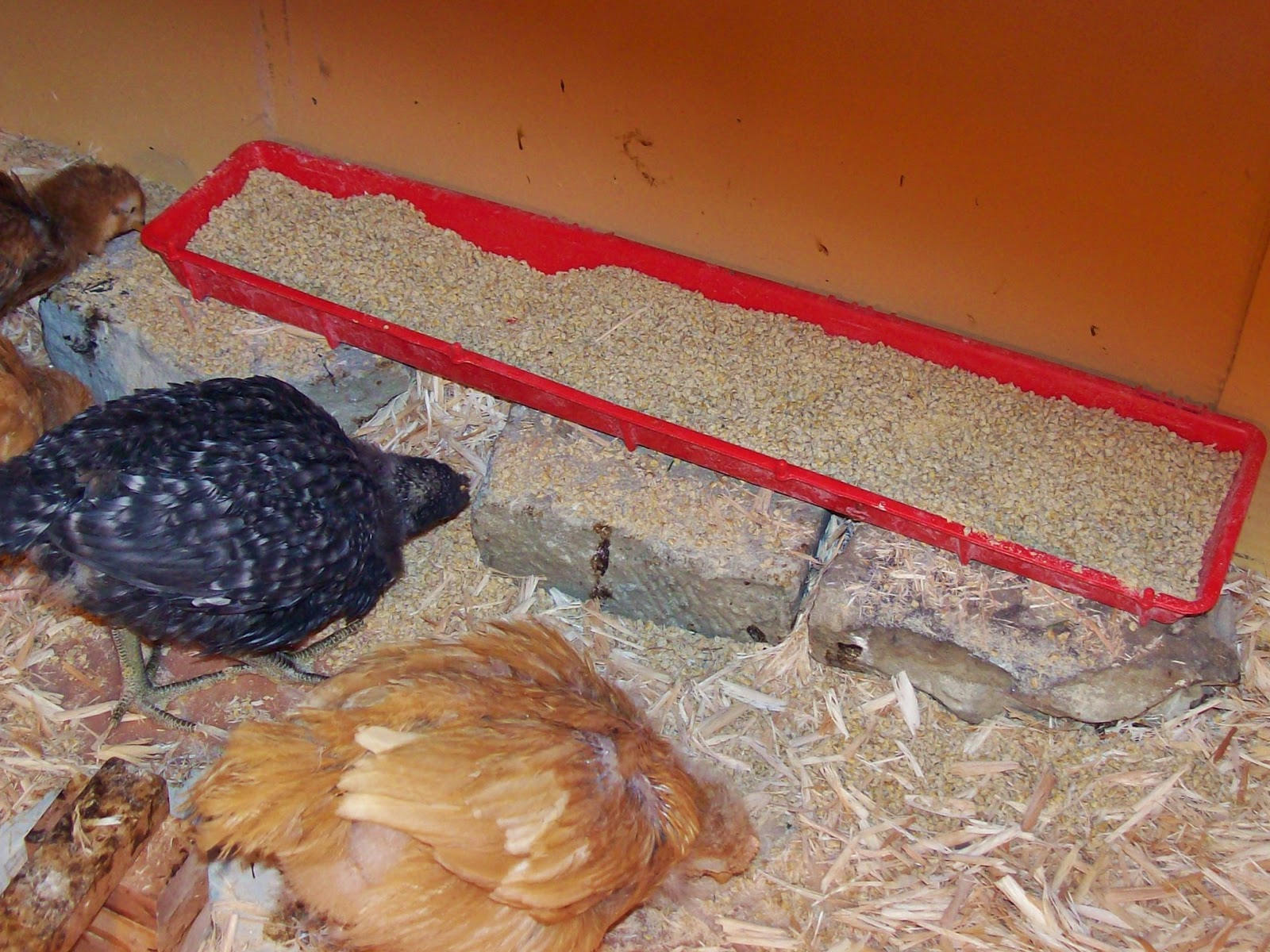
As the chicks grew bigger, there were constant changes. Raising the feeder was the first challenge. Having the feeder at floor level worked fine for small chicks, but as they got bigger, they were able to kick large amount of litter into the feeder. This got to be very inconvenient to clean out, as well as wasting food. So I found some small flat rocks and cement blocks to raise the feeder just a few inches off the floor. I also had to remove the hinging top with holes from the feeder (you can see it here) since the chicks' heads were nearly too big to fit into the holes. As you can see, they took full advantage of that fact and shoveled plenty of food out onto the rocks and floor.

Monday, September 1, 2014

Combination

Backyard Poultry
Joining the Roost
Did you spot the newcomer on the roost above? Yes, it's the little brown Rhode Island Red! Finally, it was time to combine the two little flocks of chicks. The Rhode Island Reds had grown big enough that I thought they could hold their own in the older flock. Anyway, they had certainly grown big enough to be very crowded in their little pen. Also, and just as importantly, they had graduated from chick feed to grower feed, and thus could eat the same thing as the larger flock. The chick feed has a higher protein content, needed for the extraordinarily fast growth the chicks experience in the first few weeks of life. At around 3 weeks, they can move to grower feed with a lower protein level. The combination went quite smoothly: the Reds were happy to explore the living quarters they had only been able to see for so long, and the older chicks seemed to take the Reds right in as part of the flock.
Sleepy Time
As you can see, the Reds seemed to fit right in. In fact, they seemed to almost see the older chicks as some sort of surrogate mothers!