Only the best from a bulletin board full of experience in such varied interests as poultry, art, good food, and Ohio history.
Come along on the adventure!


Be sure to also check out ohloveofgeocaching.com for travel and geocaching adventures, sunlight-shadows.com for original poetry, and bloggingforhopeandcourage.com for inspiring photos!
Showing posts with label pre-1700. Show all posts

Tuesday, June 23, 2015

Valley View

Ohio History
Fort Ancient Plateau
Just before we left Fort Ancient, we enjoyed this view from a wooden lookout platform. Gazing across the plateau, we could almost make out in places the earthen mounds of Fort Ancient. This plateau is 235 feet high, and overlooks the Little Miami River valley. Fort Ancient covers the 100 acres on the very summit of the plateau. Far in the distance, you can almost see the drop in elevation and descending treetops. The Native Americans chose carefully when finding a spot for such a work of earth. Fort Ancient truly is a fascinating place.

Sunday, June 21, 2015

Gateway Mounds

Ohio History
The Great Gateway
As we drove away from the museum inside Fort Ancient, we passed through these two mounds. If I am not mistaken, this is the Great Gateway. Two exceptionally large mounds join the northern and southern parts of Fort Ancient. They create a gateway that is the primary entrance to the southern area of the enclosure. According to the sign, there is also a small mound that was built just south of the Gateway mounds. It connects to a stone pavement that runs 150 feet into the southern enclosure. I don't believe we saw it, although apparently it is still in tact, since we did not get out of the car. But if you look closely at the left-hand mound in the picture, you can almost see a smaller mound down in front. It was pretty cool to drive through the opening between these two mounds!
More Mounds
Here is another road between two mounds that we saw as we drove out of Fort Ancient. I don't remember if we were still inside the enclosure or not, but it was surprising how many mounds we could spot even from inside our car.

Friday, June 19, 2015

More Mounds

Ohio History
A View of the Earth Wall . . .
We walked along the wall for a ways, following its winding contour. It was amazing to see how high it was in some places. And to think it had stood for perhaps over a thousand years without eroding back into the ground! The Hopewell took great care in the construction process. In fact archaeologists now believe that the walls were built over the period of several hundred years. In the beginning stage, they created a base of gray clay. On top of this was heaped three low, parallel mounds of earth. These mounds were then painstakingly covered with countless basketfuls of soil, creating the second stage of construction. Amazingly, archaeologists have been able to identify the outlines of individual loads of dirt in cross sections of the wall.
. . . And Another View
In the third stage, a final cap of soil was added to top off the mound. Limestone slabs were also applied on the exterior of the mounds where more stability was needed. These have been found in particular on the eastern end of the enclosure. It is amazing to think how all this soil and rock was hauled to this construction site, especially considering the high elevation of the plateau where Fort Ancient is built. Above you can see another section of the mound wall, this one even higher than the last.

Wednesday, June 17, 2015

Fort Ancient Mounds

Ohio History
Earthen Wall
Now it was time to see the Fort Ancient mounds themselves. We drove down the length of the enclosure from the museum to the more narrow central area. Up close, the walls of earth looked almost like small hills; they were overgrown with grass and trees. Inside are conical and crescent-shaped mounds, flagstone pavements, and stone circles, some of which you can see in the aerial view below. There are also 67 "gateways" or openings in the wall of the enclosure, turning down the possibility of the wall being built for military defense. Instead, archaeologists believe the site was used as a religious and social center for the Hopewell Indians who built it. Some of the walls and mounds may even function as astronomical calendars. The Fort Ancient people who came after the Hopewell may have used it for similar purposes. These people likely lived in villages along the Little Miami River and possibly within Fort Ancient itself. Below is an aerial map of Fort Ancient that we saw on a sign:

Monday, June 15, 2015

Indian Canoe

Ohio History
Transportation by Water
Outside the Native American dwellings were a few things you might have found in an Indian's backyard. The canoe above was very interesting. We could see the marks where it had been carved out of a solid log. The ends had been carefully chiseled to a point to glide smoothly through the water. I was struck again by how small it was. I can't imagine sitting in this little boat out in a wide river though. I wonder if these canoes ever tipped over? I think I might opt to walk if I was an Indian. But then, there were no real roads, and waterways served as the highways in Indian days. Travel could be accomplished so much more quickly, and these shallow canoes could navigate all but the smallest streams.
Herb Garden
Nearby was a pretty little garden. It is amazing to think how much the Indians know about different plants and what they could do medicinally. I recognized the yarrow although it was not yet flowering; its yellow flowers can be dried and used for tea for a cold or infection. I believe that is bee balm in the back, and possibly some lavender in the front right corner. The Indians also knew how to gather many wild plants and herbs that were beneficial for all kinds of ailments. However, some plants were cultivated out of necessity or for convenience. 

Saturday, June 13, 2015

Indian House

Ohio History
House of Grass and Sticks
I guess you could call this house a step up from a wigwam. It is a typical dwelling from the time of the Fort Ancient people. Villages could hold 200-500 people, and were sometimes surrounded by a stockade for protection from hostile tribes near by. There is even evidence that people may have lived inside the walls of Fort Ancient. This house reminded me of the Indian longhouse and may have held just as many family groupings. It was constructed of larger, sturdier sticks than the wigwam, and covered with sheaves of dry grasses. I imagine that the top would also have been covered, perhaps with more grass or bark. We enjoyed walking into the house and imagining what it would have been like to live there so long ago.

Thursday, June 11, 2015

Indian Wigwam

Ohio History
Wigwam Frame
After our walk through the museum, we stepped back outside into the bright sunshine. There were more things to learn about Native Americans outside. Above is the beginning of a life-sized wigwam that we saw. The frame was built of long, flexible sticks that were thin yet strong. I can imagine sapling trees being cut down and having the branches stripped off. Poles were inserted into the ground to form hoops, and then the horizontal sticks were lashed on with thin strips of bark. The wigwam would then be covered with layers of some kind of bark to keep out the snow and rain. It's a warm weather version of an igloo, really. I was surprised at how small this one was, and it would seem even smaller once it was covered in bark. A slight contrast to today's houses...

Tuesday, June 9, 2015

Trading

Ohio History
Meeting of Two Worlds
The Historic Native American time period, 1700 to present, is characterized by interaction with the Europeans. Tribes in Ohio included the Delaware, Wyandot, Shawnee, Iroquois, and Miami. Native Americans began to trade with white men, as seen above, until those white men became settlers taking over their land. The 1795 Treaty of Greenville created an Indian reserve in northeastern Ohio, but by the 1800s even this area was taken over for European settlement. Missionaries made efforts both to convert the tribes and to teach them to become farmers in western-style settlements. Some tribes established successful settlements, such as the Shawnee at Wapakoneta. However, even these were suppressed by the U.S. government. Leaders like Tecumseh rose up, charging the Indians to go to war to stop the takeover of their land. Though they had temporary victories, eventually all tribes were pushed out of Ohio. However, they left behind many things to be remembered by, including Fort Ancient.

Sunday, June 7, 2015

Indian Papoose

Ohio History
Indian Baby
This adorable little papoose was in the next diorama featuring the late Prehistoric Indian time period (900-1600). Groups in Ohio included the Monongahela, Sandusky, and  Fort Ancient. The Fort Ancient Indians from this time period were originally thought to have built Fort Ancient (hence the name), but archaeologists now believe it was built much earlier by a Hopewellian people. The Prehistoric Native Americans lived in villages, hunting and farming the fertile land for food. Each tribe had distinctively decorated pottery. Perhaps that is what the mother of the little Indian papoose is doing nearby in the picture below. Although these groups of people never directly contacted Europeans, they began to feel the effects of colonization through disease, technology, and loss of hunting lands.

Friday, June 5, 2015

Indian Eskimos

Ohio History
First Indians
The Fort Ancient Museum traced the history of Native Americans through a series of life-size dioramas. This scene depicts the people believed to be the original ancestors of Native Americans. They may have migrated from Asia, down through Canada, to settle in present-day Ohio. Their rich furs and strong stone dwelling would have been very important for survival during this journey. These immigrants would have become the Early Woodland Indians (around 800 B.C.), the earliest people described in the museum; they included hunters and gatherers, as well as the Adena who built small mounds. The Middle Woodland/Hopewell Indians followed them, building more complex earthworks and using pottery and flint. In A.D. 500, they become the Late Woodland Indians, utilizing crops and the bow and arrow for food. A.D. 900-1600 is labeled with the Prehistoric Indians; last of all are the Historic Indians from 1700 to the present. We will see both of these groups next.

Wednesday, June 3, 2015

Fort Ancient

Ohio History
A Relief Map of Fort Ancient
It's time for another road trip to an point of interest in Ohio. We will be heading for the Fort Ancient Earthworks and Nature Preserve in Oregonia, Ohio, an hour northeast of Cincinnati. This National Historic Landmark was Ohio's first state park, owned by the state since 1891. But, of course, its history goes much further back than that. Fort Ancient consists of almost three and a half miles of earthen walls up to 68 feet wide and 23 feet high. They enclose roughly 100 acres on the top of a high plateau that overlooks the Little Miami River. The 3D topographical map above shows the earthen walls at the edge of the clearing, just before the descent to the river valley begins. Despite being called a fort, archaeologists now believe this enclosure was a space for social and ceremonial events rather than for defense.
Another View of Fort Ancient
The Fort Ancient museum was located inside the earthen walls of Fort Ancient, at the other end of the enclosure. If you look closely at another segment of the topographical map shown above, you can pick out the earth walls. The white-roofed building in the center is the museum, which we will be visiting here in a minute. Then we will take a hike to see some of the walls themselves.

Thursday, September 5, 2013

Paint Palette

Ohio History 
Paint Palette from Behalt
Can you imagine using a mess like this to create the beautiful pictures in my last post? That's what the Behalt artist, Heinz Gaugel, did. Well, he'd already had a lot of practice. Born in the German Alps in 1927, he moved to Canada in 1951 to begin his self-taught artistic career. Mr. Gaugel created ceramic, stained glass, fresco, and painted art for both public and private buildings and churches.
That all changed in 1962 with his first visit to Holmes County, Ohio. After hearing an Amish blacksmith's wish for a place where tourists could find out why the Amish live the way they do, Heinz Gaugel began detailed research into Anabaptist history. Painting commenced in 1978 in his private workshop, until 1989 when the partly finished mural was moved to the Amish & Mennonite Heritage Center. Visitors could watched Behalt's progress until 1992 when Mr. Gaugel completed the massive canvas cyclorama, a complete circle measuring 265 feet in diameter.
Sgraffito - German Immigrants
The outside of the museum had another larger-than-life depiction, though much smaller than the mural. Immigrants' Arrival in the New World was also created by Heinz Gaugel using a technique of reverse art called sgraffito. First layers of contrasting colors of plaster are applied to the surface, and then carefully scratched off to create the picture. I'd never seen anything like it!


Tuesday, September 3, 2013

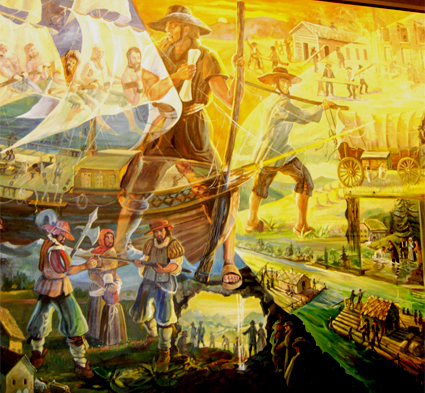
Behalt Murals

Ohio History
Behalt Scenes
Here are a few close-ups from just a small area of the mural. The number of figures and scenes packed into the painting was simply amazing! The pictorial story began in Zurich, Switzerland in 1525 where the Anabaptist movement originated, in the context the Roman Catholic Church and the developing Reformation. Important leaders and events in Anabaptist history were then depicted, leading to the emergence of the Mennonites, Amish, and Hutterites. Can you pick out all three in the scene pictured above?
Era of Conflict
The pictures simply flowed into each other as though geometric shapes of color had been laid overlapping across the scenes. In fact, the colors actually symbolized different eras of history--red during times of persecution, blue to show peace, yellow for excitement. We learned that the artist made initial charcoal sketches of the scenes before using brilliant oil paints on these enormous canvases. More on the artist in my next post!

Saturday, August 31, 2013

Behalt Museum

Ohio History
The Mural
Our next stop will be on the other side of town, a few miles north of Berlin: the Amish and Mennonite Heritage Museum. Contrary to its somewhat boring name, this museum showcases an amazing piece of artwork. The Behalt Cyclorama, measuring a full 265 feet long, preserves the heritage of the Amish and Mennonite peoples from the Reformation to today. This 10-foot-high circular mural derives its name from the German word behalt which means to keep or to remember. The door sign pictured above did not prepare us for what we saw as we entered the museum.

Wednesday, November 16, 2011

Leo Petroglyph

Ohio History
Rock Carving
Now we’re back on windy roads into the rough, wooded hills of Jackson County. Our next stop was not a museum at all, just a large rock in the ground inside a picnic shelter. But this sandstone bedrock is very unusual, for on its surface are carved 37 prehistoric pictures, or petroglyphs. They are attributed to Fort Ancient Indians from about 700 years ago. Their purpose remains unknown—possibly tribal symbols or a pictographic history. Among the figures are birds, snakes, fish, human figures, and different kinds of footprints. The image above is unidentified: it looks something like a bird’s head and wings to me. What do you think?
Stone Fish

Thursday, September 1, 2011

Flint Arrowheads

Ohio History
Flint Cores and Arrowhead
Here are some fine examples of the flint once it's been removed from the rock. These are the cores left over from large pieces of flint that have been chipped off to make tools. The arrowhead in the insert has been napped down to a razor-sharp blade on each side and tied to the stick with deer sinew (yuck!!). What is your favorite color of flint? I like the beautiful pinks, as well as the unusual deep blue you sometimes find.

Wednesday, August 31, 2011

Flint Ridge

Ohio History
Flint in the Rock
Did you ever wonder how the Indians made the tools to build all those mounds...and manufactured spearheads, arrows, and knives? We found out at the Flint Ridge Museum (also in Newark)—with flint! This beautiful, hard rock was mined in flint pits, then napped, or filed down, to nice sharp points. After marveling at the colorful samples of flint in the museum, we saw old flint-mining pits used by the Indians in the surrounding woods. The settlers even used flint for grindstones in their first mills!

Tuesday, August 30, 2011

Great Circle Mound

Ohio History
Into the Mound
Now for the real Indian stuff. Descending this stairway into the Great Circle Earthworks, we were surrounded by dirt walls. The ring-shaped mound stretching 1,200 feet across was really amazing—imagine hauling and shaping this much dirt with only hand tools and baskets! Inside the circle lay several smaller mounds called the Eagle Mound, as they resemble a bird in flight. An open gateway had been left at one end, and we had a good cross-section view of the towering height of the dirt walls!