Only the best from a bulletin board full of experience in such varied interests as poultry, art, good food, and Ohio history.
Come along on the adventure!


Be sure to also check out ohloveofgeocaching.com for travel and geocaching adventures, sunlight-shadows.com for original poetry, and bloggingforhopeandcourage.com for inspiring photos!
Showing posts with label Hayes House. Show all posts

Saturday, March 10, 2012

Birds Snowflake

Ohio History
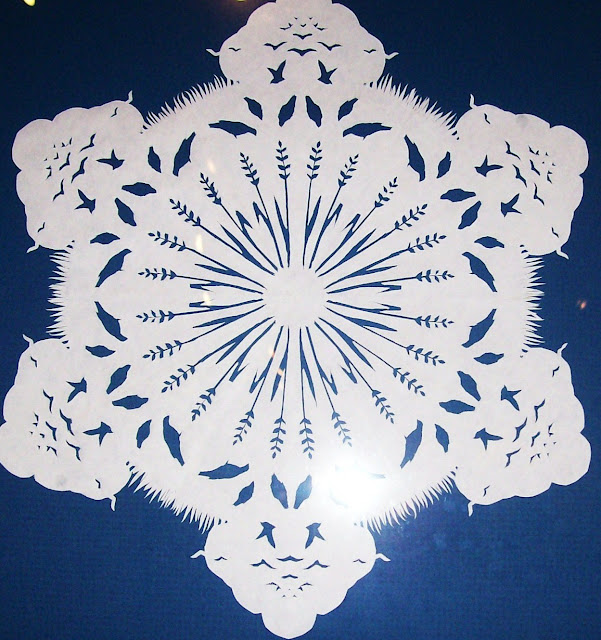
Birds of the Air
Look at all the birds on this one! I never thought there were so many different silhouette shapes for birds!! This snowflake must have been a difficult one—can you imagine cutting out those tiny stalks of wheat? The detail sure is mind boggling on this one. It comes from Matthew 6:26:

"Look at the birds of the air, for they neither sow nor reap nor gather into barns;
yet your heavenly Father feeds them.
Are you not of more value than they?"
Friday, March 9, 2012

More Snowflakes

Ohio History
Treasures in Heaven
I like the little moths in the center of this snowflake. It’s one of the more complicated patterns, with trees and people around the outside, topped by stars. You can spend quite a while studying any of the snowflakes, and more pictures will pop out! This one represents Matthew 6:19-20:
“Do not lay up for yourselves treasures on earth,
where moth and rust destroy and where thieves break in and steal;
but lay up for yourselves treasures in Heaven,
where neither moth nor rust destroys and where thieves do not break in and steal.”

The Matt. 5-7 series included many diverse patterns and pictures—people, plants, flowers, stars, clouds, and butterflies, to name a few. One even had pig faces on it (“Do not cast your pearls before the swine”).

Wednesday, March 7, 2012

Paper Snowflakes

Ohio History
Light of the World
The final attraction at the Hayes Museum appeared at first to be a bunch of large snowflakes. They were created by a surgeon from Michigan named Thomas Clark. Otherwise known as “Dr. Snowflake,” he specializes in this intricate cut-paper art. Most of us have probably folded a circle in quarters and cut out little notches to make a snowflake. Well, Dr. Snowflake used the same technique to create an array of tiny pictures within an 8” or 10” paper circle. It was truly amazing!
There some Christmas-themed snowflakes and a few designs featuring the planets. But the largest collection was a series picturing Bible verses from Matthew 5, 6, and 7. This snowflake illustrates Matthew 5:14:
“You are the light of the world.
 A city that is set on a hill cannot be hidden.
Nor do they light a lamp and put it under a basket, but on a lampstand,
and it gives light to all who are in the house.”

Monday, March 5, 2012

Model Trains

Ohio History
Trains in the Village
Here’s a view of the other side of the layout with two passing trains. I think the one on the left ran on an interactive switch. It even has lights in the passenger cars! The short one with yellow cars is also in one of my previous pictures. Head over to J Beachy Photography if you want to see an extraordinary video of a model train in action. It’s really awesome, complete with scenery and music!

Sunday, March 4, 2012

Exploring the Trains

Ohio History
Ski Lift and Trolley Car
Besides watching the trains chugg around the tracks, we could also try out interactive buttons all over the layout. Some of them operated model trains on short sets of tracks. Others sent children’s swings, tiny ice skaters, and a carousel (with lights & music) into motion. We could even move the ski lift up and down a snowy mountain! Above you can see both the ski lift and a little trolley car (which got stuck every time we tried to run it!).
Railroad Crossing
Here is the little railroad crossing station. The door opens like this and the little man pops out when you press the button. I think it’s so cute!
Below is a scene with a lighted church, ice skaters (that lake is actually a mirror), and a train. Those cows in the background caught my eye—what on earth are they doing in the snow outside a hardware store?? 
Cows in the Snow


Saturday, March 3, 2012

Hayes Train Layout

Ohio History
Second & Third Levels
The train layout was fascinating to examine—countless tracks ran in every direction, through tunnels, railroad crossings, and stations! Green turf and plenty of cotton stuffing created the snowy backdrop for a village scene with miniature houses, shops, churches, and depots. Many were even lit by tiny electric lights. Did you spot the two trains coming ‘round the bend? I’ll tell you, it was a challenge to get all the moving trains lined up for a picture!
Trains and Village
The six large trains replicated actual styles in use during President Hayes’ time. Railroads were crucial during the Civil War and Mr. Hayes probably rode them frequently. I’d say that both of these look like passenger trains; what do you think?

Wednesday, February 29, 2012

Hayes Train Special

Ohio History
Model Train Layout
The highlight of Hayes Museum at this time of year is a special Christmas exhibit called the Hayes Train Special. Chugging around an extensive snowy village layout were six model trains, ranging in size from (I’m guessing) O-scale to G-scale. The three-tiered layout measured a good twelve by twenty-four feet. It was completely amazing! Especially since it’s a mobile display—dismantled and set up at different sites regularly! I like this picture of the two trains whizzing by on the second level, with lighted houses on top.

Monday, February 27, 2012

Presidential Carriage

Ohio History
Hayes Buggy
How would you like to see the forerunner of the Presidential limousine? May I present...the White House Carriage of President Rutherford B. Hayes. It was purchased in 1877 for only $1,150, plus horses for $900 more—and didn’t run on gasoline! At least seven Presidents and a number of important generals have ridden in the carriage. It served President Garfield during his term, then was used by the Hayes family until 1893. From the pictures it looked like it was actually a convertible, with a fold-down roof and sides. It was luxury for that time!

Sunday, February 26, 2012

Indian Pipe Pouch

Ohio History
Arapaho Gift
You don’t think much about Indians after the Civil War, but western lands were actually still such a hot issue that President Hayes began a new Indian policy. It went like this:
1) Concentrate them on reservations, 2) teach them self-sufficiency and “civilization,” and 3) send Indian children to boarding schools to immerse them in European ways. This opened up even more land for settlers, though the Indians were obviously not too happy with the whole deal. Native American delegations and chiefs often came to the White House to “negotiate” (invariably losing their land to the government). President Hayes received this pipe pouch on one such occasion in 1877 from an Arapaho chief named Black Coal.

Friday, February 24, 2012

Hayes Sideboard

Ohio History
Hayes Sideboard
In the Whitehouse, President and Mrs. Hayes ordered this magnificent mahogany sideboard to use in their private dining room. Delicate floral and nature designs fill the door panels, flanked by intricately-carved moldings. The sideboard was constructed by a carpenter in Cincinnati, Ohio; he also made along a matching dining table, which was later remade into two side tables by President Chester Arthur. The dishes on display are from a Hayes set of White House State china. It’d be something to see it in the White House!
President Hayes was known for his honesty during a difficult post-Civil War period. He ended the controversial “Reconstruction” and sought moderate treatment for the South, while somehow avoiding friction with Congress. Maybe his resolve not to run for a second term helped.

Thursday, February 23, 2012

Hayes Election

Ohio History
"Inaugural Plank"
Rutherford B. Hayes ran for President in 1876 while he was still governor. It was a very close election—only a difference of 250,000 votes between him and his Democratic contestant Samuel Tilden. A special commission had to be formed to make the final decision, and Mr. Hayes won by only one electoral vote, just three days before inauguration!
Presidential Oath Bible
President Hayes took the oath of office at a private dinner in the White House a day early. Since Inauguration was on a Sunday, and thus would be observed on Monday, they did not want to leave the nation without a President for a day. He was also a little wary of Samuel Tilden, who was bitter about losing the election. Above is the Bible Mr. Hayes used to take oath of office. The black arrow marks the exact place where he put his hand!

Monday, February 20, 2012

Governor Chair

Ohio History
Hayes Chair
When the Civil War came, Mr. Hayes enlisted in the Union Army. He became a general and was wounded several times. After the war, he served in the U.S. Congress for four years, then was elected governor of Ohio in 1868 and 1875. If you can believe it, this is the chair that Governor Hayes used while in office. I was surprised at its striking similarity to office chairs today! By the way, I should mention that Mr. Hayes married Lucy Webb Hayes in 1852, and they had eight children altogether.

Sunday, February 19, 2012

Hayes Law Desk

Ohio History
Law Desk
We began with a tour of the Hayes house. The 31-room mansion featured high ceilings, fancy furniture, and ornate trim, culminating in a four-story staircase which led to a rooftop viewing area. However, this was the only historical house we visited where we weren’t allowed to take any pictures at all. A guard actually followed the tour group to enforce the rule! There weren’t even postcards of the interior—it was a disappointment after driving so far!
Consequently, my pictures will start in the Hayes museum near the house. Rutherford Hayes was born in Delaware, Ohio. After receiving a degree in law, he set up his own law firm in Cincinnati. Above you can see the desk he used as a lawyer.

Saturday, February 18, 2012

Hayes House

Ohio History
Spiegel Grove
Revived from the fresh air, we got back on the road all the way to the Hayes House in Fremont, Ohio. Rutherford Hayes’ uncle, Sardis Birchard, purchased this rambling, wooded estate in 1846. He named it Spiegel Grove for the rainwater pools under the trees that looked like mirrors (spiegel is German for mirror). Uncle Sardis built a house there in 1859 for his nephew’s family, and they lived there with him on and off. Mr. Hayes inherited the estate and moved there permanently after he left the White House. Twenty-five acres of Spiegel Grove is preserved today in the Rutherford B. Hayes Presidential Center.