Dolls are not the only special exhibit I have visited at the National Afro American Museum. My family returned to the museum a year later to see a special display of quilts. On our way in, we stopped to admire this beautiful basket collection. There were baskets of all shapes, sizes, and colors - certainly serving artistic purposes as well as practical. A sign explained how some baskets were woven, such as the ones on the left-hand side with a square checkerboard appearance. Others were coil baskets, made from concentric circles of material fastened together. The purple-accented baskets at the top right are examples of coil baskets. I was amazed to see the varied purposes of the baskets, ranging from gathering and storage to table ornamentation. It would certainly be fascinating to watch the process of making one of these baskets!
Only the best from a bulletin board full of experience in such varied interests as poultry, art, good food, and Ohio history.
Come along on the adventure!
Be sure to also check out ohloveofgeocaching.com for travel and caching adventures!
Come along on the adventure!
Be sure to also check out ohloveofgeocaching.com for travel and caching adventures!
Showing posts with label 1950-2000. Show all posts
Thursday, March 5, 2015
Tuesday, March 3, 2015
Cabbage Patch Dolls
Ohio History
| Cabbage Patch Family |
And finally, last of all, we meet the Cabbage Patch babies. Don't you just have to smile at them, all decked out in their grown-up clothes? The sports uniforms are so cute. These are some of the few dolls in the Afro American Museum exhibit that might appeal to boys. Cabbage Patch dolls were first manufactured in 1978 under the name Little People. They reached their height in the 80's, but continue to be sold today. I remember growing up with several Cabbage Patch dolls, including the bald-headed Baby Rose doll who always had to wear her little pink hood. My sister's doll was named Lily, and believe it or not, she was identical to the astronaut doll in the display. At first we thought Lily had decided to go to space! I must say, a Cabbage Patch doll looks pretty good in a spacesuit!
| Lily the Astronaut |
Sunday, March 1, 2015
Talking Doll
Ohio History
| Speaking Baby |
My sister and I thought this talking doll was especially cool. I wish I could have actually heard her talk! She is once again on the dark end of the skin tone spectrum, with typically-portrayed African features. There is ongoing controversy about exaggeration of racial features on dolls for children. A museum sign did discuss how giving African American children ethnically correct dolls allows them to build self-esteem and self-acceptance. Such dolls are also beneficial to children of other cultures, helping to make them open to people of all racial backgrounds. It was interesting to consider the many roles this doll could have played in a child's life.
Friday, February 27, 2015
American Girl Doll
Ohio History
| Addy the American Girl |
This doll from the American Girl collection filled a complete display case with her accessories. Named Addy Walker, based on the African name Aduke, she was released in 1993. She was the company's very first African American doll. This is remarkable since American Girl had been producing dolls since 1986 and had already released Native American and Mexican characters. Addy was the fifth historical character of the American Girls and represents the Civil War era. She is based on the American Girl book series by her name, in which Addy and her mother escape from slavery to Pennsylvania. The books explore economic and social issues through Addy's life in Philadelphia. The scene below is from the second American Girl book, Addy Learns a Lesson.
| Addy at the Schoolhouse |
Tuesday, February 17, 2015
Car & Cameras
Ohio History
| Orange Car |
This car was also on display in the Fifties exhibit. It reminds me of the ones you see in those really old TV shows. Quite classy, I must say, though orange wouldn't be my top choice. But interestingly enough, I just saw an orange car at the Ohio History Center's Fifties exhibit nearly identical to this one!
| Old Cameras |
There were also plenty of smaller artifacts on display. These cameras were especially interesting. Of course, they were a great improvement over the large black boxes with hoods on those big stands, where taking one photograph was a long production. But compared to today's cameras, these are still big and cumbersome. And check out the flash bulb apparatus on the left hand device. Now we have devices an eighth the size that not only take pictures, but also access the Internet, make phone calls, and so much more. What a difference 75 years makes.
Sunday, February 15, 2015
Kitchen
Ohio History
| Afro-American Kitchen |
Just across from the living room was a Fifties-style kitchen. Despite the fact that it contained basically the same elements as today's kitchen, the distinct mid-twentieth century look was obvious. White aluminum, clean rounded edges, and silver accessories characterize appliances from this time. Not to mention the sea green floor. Of course, there are a couple vitally important things missing, such as the microwave, dishwasher, toaster, and coffee maker. I don't know how they ever got along back then! In any case, this family was definitely well-to-do with such a modernly furnished kitchen. In fact, many African Americans who had been involved in World War II were very well off during the Fifties.
Thursday, February 12, 2015
Living Room
Ohio History
| Fifties House |
The Fifties exhibit at the National Afro American Museum featured a partial life-sized house with historical furniture. The living room did not look much different from our own, except for the bright colors and patterns. I can't get over the orange couch! Black panther figurines like the one on the coffee table were common during the time. Many were symbolic of the Black Panther Party, which positioned itself as an African American nationalist organization. This was just one group under the term "Black Power" advocates, which sought racial freedom using more aggressive methods.
| Living Room |
A nearby display discussed the high importance of family to the typical African American of the Fifties. Distance was not a factor when coming together to celebrate family events (weddings, reunions, funerals, etc.). Most households included not only two-parent families, but also grandparents, cousins, and unmarried adult children. So I can imagine a house like the one above could have been quite crowded.
Monday, February 9, 2015
National Afro American Museum
Ohio History
| Signing of the Civil Rights Act |
And now it is time to pay a visit to another Ohio historical site. The National Afro American Museum and Cultural Center in Wilberforce offers a unique combination of arts, culture, and history for a diverse visitor experience. The museum's main display focuses on the Afro-American experience in the US during the Fifties (1945 - 1965). This era was characterized by demographic and social changes in the Afro-American community. These events are chronicled throughout the museum through wall-size photographs, such as the one above, a historically-furnished house, and many period artifacts such as the poster below. This sign from the Freedom Movement stresses the fact that racial freedom is economic as well as political.
| Civil Rights Sign |
Saturday, July 26, 2014
Apollo 15
Ohio History
| Command Module |
Satellites were not the only vehicles to enter space. Exploration of the moon set a new goal for the world powers. And it did not end with putting a man on the moon. Tests and observations of the moon continued. This Apollo 15 Command Module, Endeavor, was the fourth of the Apollo missions to land astronauts on the moon. It made its flight in 1971, taking four days to get to the moon and spending almost three days there. The crew conducted experiments and took photographs. The Apollo spacecraft had three major components: the command module, the service module and the lunar module. The service module carried equipment, as well as containing support and propulsion systems; the two crewmen traveled to the moon's surface in the lunar module. They returned to earth in the command module. It measures about 10 1/2 feet high and less than 13 feet in diameter. We read that the size inside is about the same as a minivan - it's hard to imagine traveling through outer space in that!
Thursday, July 24, 2014
Satellite
Ohio History
| DSP Test Satellite |
Finally, we reached the last section of the museum: space. Space innovation really advanced during the Cold War "space race" of the '60s. Satellites were the first goal, both for spying and for information transmission. The 35-foot-high spacecraft above was a test vehicle for the Defensive Support Program begun in 1970. It was an alert system that could sense thermal radiation from rocket launchers using infrared detectors. This allowed an earlier warning system for imminent missile threats. It was amazing how big it looked in the museum, compared to the pictures we see of satellites in orbit in space. These DSP satellites, as they are called, are still in use today.
Tuesday, July 22, 2014
Inside Air Force One
Ohio History
| Cockpit |
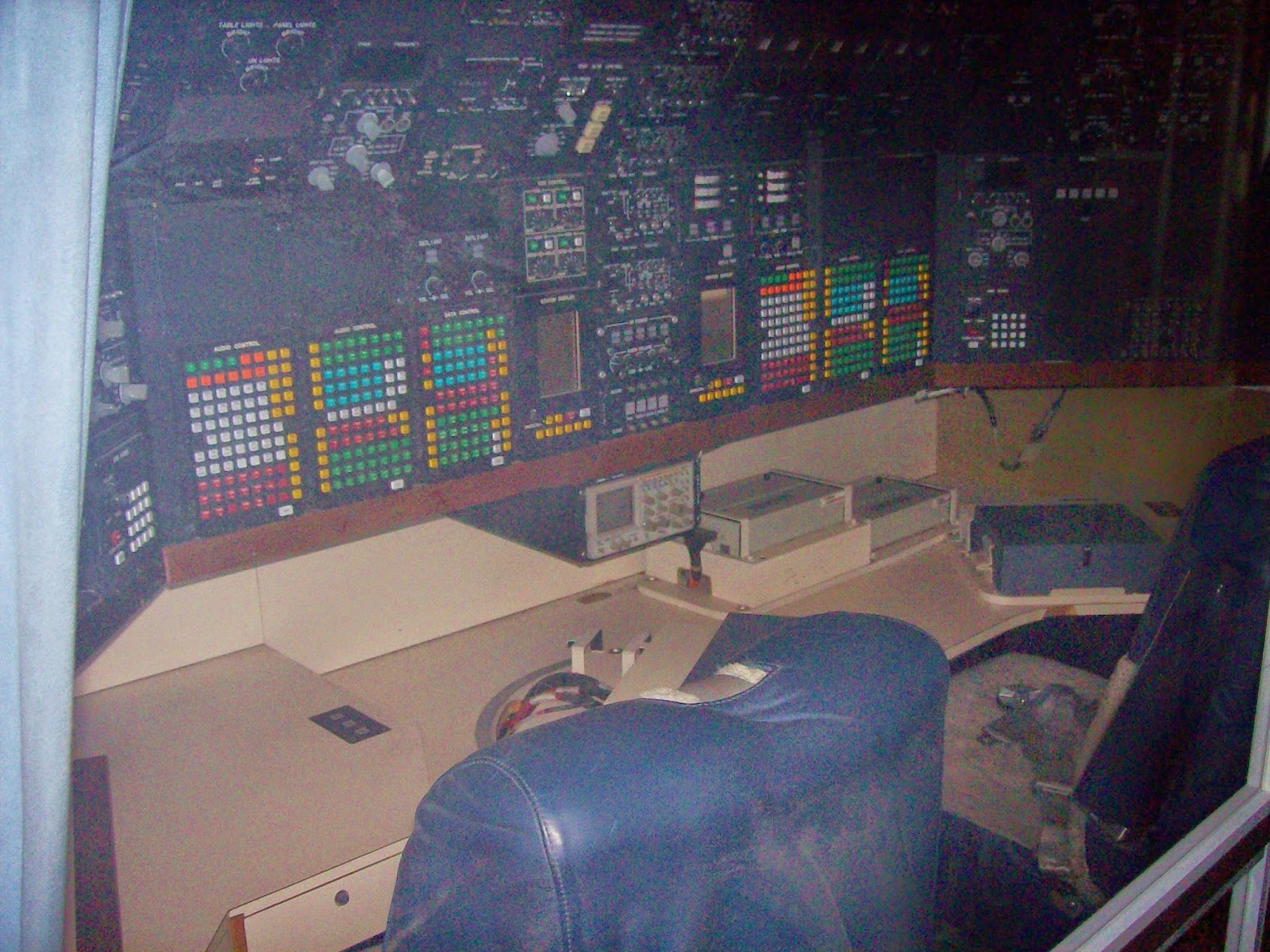
We got to walk through the Air Force One jet. It was amazing to see how the control panels and cockpit had changed from Roosevelt's plane. It took a crew of 7 or 8 to fly the aircraft. The jet could travel up to 604 mph with an altitude over 43,000 feet. Up to 40 passengers or more than 10 tons of cargo could be carried at a time. Compare this to spending days riding in a horse and carriage to even get across the country. Now the President could travel halfway across the world in a matter of hours!
| Air Force One Accommodations |
This plane saw a number of historical moments take place. It carried President Kennedy to Berlin to make his famous speech in 1963. Following President Kennedy's assassination in Dallas, Texas, Lyndon B. Johnson took the Oath of Office in the plane. There was not time for him to return to the White House, for America was without a President. Air Force One also carried President Nixon to China on his historic 1972 diplomatic visit. And in 1983, British Queen Elizabeth II flew on the plane during her visit to the United States.
Sunday, July 20, 2014
Air Force One
Ohio History
| SAM 26000 |
Now we'll jump back to the Presidential Gallery, and the first jet built specifically for Presidential use in 1962. It carried eight US Presidents over three decades, from President Kennedy to President Clinton. The jet's official name was SAM 26000, which stood for "Special Air Mission," number 26000. The call sign "Air Force One" was also used when the President was on board to make sure everyone knew where the President's aircraft was. Because President Kennedy did not give the plane a nickname like previous Presidential aircraft, the media also began to call it Air Force One. The name stuck. Check out my Roosevelt's Plane post right here to see a side view of SAM 26000 as well - it wasn't easy to photograph these big planes!
Wednesday, July 16, 2014
Cold War Conflict
Ohio History
| Berlin Checkpoint |
The Cold War conflict was expressed in a number of ways around the world. One of the first major face-offs was in Berlin, Germany soon after the post-World War II partitioning. As Britain, France, and the US prepared their sections of Berlin for a democratic self-government, the Soviet Union resisted. It cut off all ground travel to and from the city in June 1948. Unwilling to risk starting another war, the western powers began a 464-day airlift to supply West Berlin with fuel, food, and supplies. The Soviets finally lifted the blockade in May 1949, although the Berlin Airlift did continue until September. More about that in my next post.
The arms race was another facet of the Cold War conflict. The Air Force Museum displayed a number of satellites and missiles from the Cold War era. Fear and suspicion played just as big a part in the arms race as actual threats. Satellites for space reconnaissance were developed to scope out the armaments of the other side, especially missile development. They could not be shot down over enemy territory like planes, although much more powerful cameras were required.
| Satellites & Missiles |
Subscribe to:
Posts (Atom)