Only the best from a bulletin board full of experience in such varied interests as poultry, art, good food, and Ohio history.
Come along on the adventure!

Be sure to also check out ohloveofgeocaching.com for travel and caching adventures!
Showing posts with label 1800-1850. Show all posts

Wednesday, March 11, 2015

Underground Railroad

Ohio History
The Journey Ends
Our quilt journey continued from the plantation to the Underground Railroad. A green snaking path amid forest browns symbolized the winding and treacherous path to freedom. Markers commemorated the Underground Railroad stations in northeast Ohio, many of them in Cleveland where certain freedom was just across Lake Erie. Old photographs transferred onto fabric made a very interesting representation of these stations. Below, in another portion of the quilt, we see the runaway slaves hiding in the bare trees under the light of the moon, moving stealthily toward the north. It is difficult to even comprehend what these slaves went through for the right to live in freedom.

Monday, March 9, 2015

Plantation Quilt

Ohio History
Black and White
The Journey of Hope in America display at the National Afro American Museum featured over 90 quilts. They commemorated the culture and history of the African American people, inspired by the election of President Obama. The quilt above seemed an appropriate beginning for the exhibit. Its artistic images portray the vast disparity between the life of the White and the Black in early America. The symbols for justice, equity, and freedom for all contrast sharply with people being treated and traded as property. The building in the middle, Fisk University, is a thought-provoking addition to the quilt scene. Fisk University was founded just after the Civil War as a school for recently-freed slave families. It is located in Nashville, Tennessee. The school originated the Jubilee Singers, an African American a capella ensemble which broke away from traditional "Black minstrel" music. The group was begun to raise money for the school, but went on to become world famous, even performing at the White House. As you can see, the quilt is tied together in more ways than one.

Friday, February 20, 2015

First Dolls

Ohio History
Afro American Dolls
Besides its permanent historical exhibit, the National Afro American Museum also features specially-themed rotating exhibits that center on African American culture. On our first visit to the museum, we had the pleasure of viewing an exhibit of over 100 dolls spanning 200 years of history. Our journey began with the case above, showing the very earliest African American dolls of the collection. I can just imagine a small child sitting on the doorstep of a plantation shanty, cuddling the wooden doll on the far left in a blanket scrap. The likeness of the center front doll to a cotton-picking slave is remarkable. And I wouldn't be surprised if the right-hand doll were made of corn husks. It is amazing to see the ingenuity used to create such life-like playthings for the young generation.

Wednesday, September 12, 2012

Making Candy

Ohio History
Heating the Syrup
Here is the sugar boiling away on the hearth. The temperature it needed to reach depended on the kind of candy being made. Some candy was made from white sugar, some from brown sugar, and some from molasses. Once the syrup reached the perfect temperature, it was poured into some kind of mold to cool--even just on a baking sheet to be cut into little cubes. Of course, you could taste lots of homemade candy samples available in the kitchen. But only after you passed a quiz about the years that different kinds of candy first came out!

Monday, September 10, 2012

Summer Kitchen

Ohio History
Making Candy
Well, we certainly came on the right day—the ladies are up to something in the summer kitchen! In the days before you could buy a hundred different kinds of candy in packages at the store, housewives made their own candy. And that’s what the re-enactors at Carriage Hill were doing the day we visited. You can see the little pot of syrup heating beside the fire in the background. There was more candy cooling on the table. And then there’s that soupy dishwater I was talking about….it would be hard to find me working out here, and not because of the “sink” either, but the heat—that summer kitchen was warm even on a fall day! Just imagine it in the middle of summer!
 

Saturday, September 8, 2012

Farmhouse Kitchen

Ohio History
Cooking Stove
Time to head over to the farmhouse. I smell something cooking! In this little kitchen, over a wood burning stove, the housewife ladies actually cook lunch for all the farm workers! Next to the kitchen is an airy sitting/sewing room, a downstairs bedroom, and then a parlor, all with beautiful hardwood floors. And just a few paces from the kitchen door (back right) was the summer kitchen, where hot weather cooking could be done without heating up the house (no a/c, remember!).
Colorful Pantry
The pantry was also just off the kitchen. As you can see, it’s very well-stocked for winter! All the canning was done here on the farm, using produce from the garden. The kitchen sink was also here in the pantry—I can’t imagine washing dishes with no running water!

Friday, September 7, 2012

Garden

Ohio History
Carriage Hill Garden
The kitchen garden was bathed in the autumn afternoon sun. Even this late in the season, there were beans, tomatoes, peppers, and lovely herbs ready to pick in the garden. I envy this beautiful wooden slat fence. Not only does it keep out wild rabbits, deer, and loose livestock, but also the flock of chickens which free-ranges the grounds in the afternoon. Oh, I should tell you about the chickens—they’re always my favorite on the farm! It’s a flock of say 20 or 25 Barred Rocks, plus a rooster. They’re usually shut in the tall fence around their coop in the afternoon before the staff leaves; however, there’s a rebel group of 5 hens who escapes the round-up every day and gets extra time to roam the yard!

Thursday, September 6, 2012

Woodshop

Ohio History
Carpentry Tools
Welcome to the woodshop! The carpenters make some amazing things in here—we’ve seen little stools, beautiful chairs, and one man even doing some intricate wood carvings. One year we came for the Lantern Tour at Christmas time, where we went around the farm by lantern light. In the woodshop, they were working by candlelight on a very unique Christmas decoration: Very thin slivers of wood were carved off a board; they naturally formed little curly-cues and then were linked together in a decorative chain. A very ingenious idea!
At Work in the Woodshop
 

Tuesday, September 4, 2012

Blacksmith

Ohio History
In the Blacksmith's Shop
Here is the farm blacksmith shop in action. As we watched, the blacksmith heated this spike of metal in the fire, then went over to shape it with his mallet, and then brought it back to heat some more. His helper in the background was pumping the bellows to keep the fire red-hot. We could feel the heat even from outside the building! Afterward, we got to look at some nails the blacksmith had made—somewhat rustic compared to today’s hardware!

Monday, September 3, 2012

Farm Spread

Ohio History
Carriage Hill Farm
Carriage Hill Farm boasts a number of roomy barns filled with live farm animals—sheep, draft horses, chickens, and a mule. They also have a wood shop, blacksmith shop, machinery shed, windmill, pond, and a summer kitchen with a springhouse. I love the many rail fences on the farm, like the one in the front of this picture.
Hayloft in Big Barn
The largest barn, painted a classic red, houses the horses and sheep in the lower level, with plenty of good-smelling hay in the loft above. Just look at those thick wood rafters! And I almost forgot, there is a new, very large visitor center on one end of the farm, displaying old tools, a wagon loaded for market, period clothes and artifacts, and other things. Be sure to stop by the Country Store downstairs for their ever-popular selection of candy!

Saturday, September 1, 2012

Carriage Hill Farm

Ohio History
Carriage Hill Farmhouse
In 1830, a prosperous family of Virginia decided to move west. Daniel and Catherine Arnold sold their land and loaded their belongings and their five children for a long journey to Ohio. They traveled by ox-drawn wagon and settled on 158 acres near the Mad River, just north of present-day Dayton in western Ohio. Their successful farm stayed in the family til 1910, through four generations, and was eventually purchased by Five Rivers MetroParks of Dayton. And so today, visitors to the Carriage Hill Farm in New Carlisle can see farm life running just as it did 150 years ago. We enjoy this historic farm (less than an hour’s drive from us) every time we visit. Here is a view of the historic farmhouse through the trees.

Monday, February 27, 2012

Presidential Carriage

Ohio History
Hayes Buggy
How would you like to see the forerunner of the Presidential limousine? May I present...the White House Carriage of President Rutherford B. Hayes. It was purchased in 1877 for only $1,150, plus horses for $900 more—and didn’t run on gasoline! At least seven Presidents and a number of important generals have ridden in the carriage. It served President Garfield during his term, then was used by the Hayes family until 1893. From the pictures it looked like it was actually a convertible, with a fold-down roof and sides. It was luxury for that time!

Sunday, February 26, 2012

Indian Pipe Pouch

Ohio History
Arapaho Gift
You don’t think much about Indians after the Civil War, but western lands were actually still such a hot issue that President Hayes began a new Indian policy. It went like this:
1) Concentrate them on reservations, 2) teach them self-sufficiency and “civilization,” and 3) send Indian children to boarding schools to immerse them in European ways. This opened up even more land for settlers, though the Indians were obviously not too happy with the whole deal. Native American delegations and chiefs often came to the White House to “negotiate” (invariably losing their land to the government). President Hayes received this pipe pouch on one such occasion in 1877 from an Arapaho chief named Black Coal.

Thursday, February 23, 2012

Hayes Election

Ohio History
"Inaugural Plank"
Rutherford B. Hayes ran for President in 1876 while he was still governor. It was a very close election—only a difference of 250,000 votes between him and his Democratic contestant Samuel Tilden. A special commission had to be formed to make the final decision, and Mr. Hayes won by only one electoral vote, just three days before inauguration!
Presidential Oath Bible
President Hayes took the oath of office at a private dinner in the White House a day early. Since Inauguration was on a Sunday, and thus would be observed on Monday, they did not want to leave the nation without a President for a day. He was also a little wary of Samuel Tilden, who was bitter about losing the election. Above is the Bible Mr. Hayes used to take oath of office. The black arrow marks the exact place where he put his hand!

Thursday, February 16, 2012

Mill Works

Ohio History
Mill Run
The mill was closed for the winter, so we didn’t get to see inside, but we did get a look at the exterior mill works. The mill race above directed backed-up water from behind the dam to under the mill. I love this beautiful picture with three levels of water; obviously, the channel’s stone wall is a good bit older than the dam!
Underneath Mill
The water flowed underneath the mill to turn the mill turbine (it’s been since removed—see it in my Indian Mill post). This turbine turned more gears inside the mill, which eventually ground grain and corn. It was interesting to see a close-up view of how a mill works!

Wednesday, February 15, 2012

Mill Dam

Ohio History
Sandusky River Dam
The brand-new, modernized dam in the river was quite a contrast to the old mill and bridge! (It can also be seen in the first picture of my last post.) It was recently rebuilt and features a unique “ladder” which allows migrating salmon to get upstream across the dam. Don’t ask me how it works! The Sandusky River was beautiful that crisp winter day, sparkling in gorgeous sunshine.

Tuesday, February 14, 2012

Indian Mill

Ohio History
River, Mill, and Dam
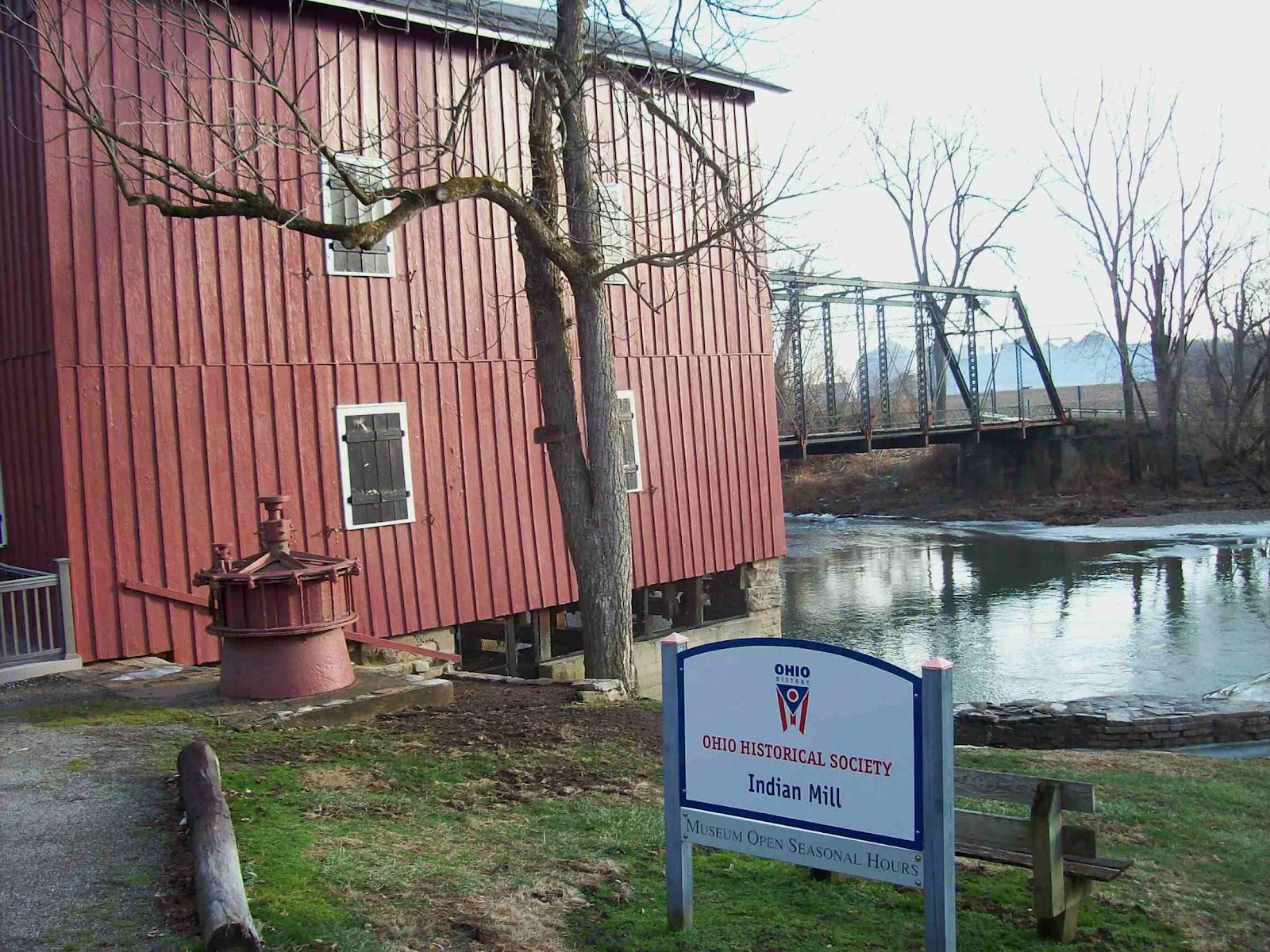
Well, we’ve had a lot of trips into southern Ohio; what about the northern part of the state? There’s one site definitely worth visiting: the mansion estate of Rutherford B. Hayes, U.S. President in the 1870s. Even if it’s a three-hour drive like it was for us! On the way, we’ll jump back fifty years and stop at Indian Mill near Upper Sandusky.
Indian Mill and Railroad Bridge
Indian Mill was built to reward the loyalty of local Wyandot Indians during the War of 1812. Incidentally, this Wyandot tribe was one of the last to be removed from Ohio in 1839, by none other than John Johnston from the Piqua Farm and Indian Agency.
Constructed by the U.S. government in 1820, Indian Mill was rebuilt into the three-story structure of today in 1861. The large red turbine from the millworks was on display outside the mill (lower left in the photo).

Monday, November 14, 2011

Peace Pipe

Ohio History
Tecumseh Peace Pipe
In 1807, a young leader named Tecumseh was rallying the Indian tribes to resist giving up land to white settlement. Fearing war, the governor asked Mr. Worthington for help (he was a trusted friend of the Indians). He brought Tecumseh and his men down to Adena for a week to talk peace, and when they left, the Indian gave him this tomahawk peace pipe. It’s now on display in the large Adena museum there at the estate.

Thomas Worthington's other political exploits included helping to write and ratify Ohio’s constitution so statehood could be achieved 1803. He went on to become U.S. Senator from 1803-07 and 1810-14, then Ohio governor from 1814-18. And, if that’s not enough, the picture on the Great Seal of Ohio is the view from the Adena hilltop across the river valley.

Sunday, November 13, 2011

Adena Gardens

Ohio History
Flower Garden
Our walk around the farm ended in the beautiful Adena gardens. Closest to the house were beds of all kinds of flowers, lined with geometric walkways. On this fall trip, the plants were dying back, but we visited again in the summer and saw some nice flowers.
Vegetable Garden
Nearby was the kitchen garden, with many different vegetables—squash, cukes, greens, beets, and beans. Servants would have been the ones who maintained the large garden which supplied all the family’s veggies. In the back of this picture is the third garden area: what is left of the arbor and its fruit trees. It certainly would be a lot of work to keep all this up!

Saturday, November 12, 2011

Tenant Quarters

Ohio History
McCormick Kitchen
Doesn’t this room look out of place on the Adena estate? It's an example of the tenant houses occupied by farm workers. The quarters were very modest--only two rooms and an upstairs. This one belonged to George McCormick, the resident cabinet-maker, who did all the woodworking in the Worthington home. He did an excellent job, as we saw several of his tables, bureaus, sideboards, and clock cases still in the mansion.